Deep TMS · BrainsWay H7 coil
TMS for OCD — a different coil, a different target.
The BrainsWay H7 coil is FDA-cleared specifically for obsessive-compulsive disorder. It is not the same device or the same treatment as TMS for depression, and it is worth understanding why if medication and therapy haven't gotten you where you need to be.
Medically reviewed by C. Britt Beasley, MD · Last reviewed June 10, 2026
The mechanism
Why OCD needs a different coil
The brain circuits most implicated in OCD — the medial prefrontal cortex and anterior cingulate cortex — sit several centimetres below the surface, deeper than the dorsolateral prefrontal cortex targeted in depression treatment. A conventional figure-8 TMS coil produces a field that falls off quickly with depth, which is a real constraint when the target is deep rather than superficial.
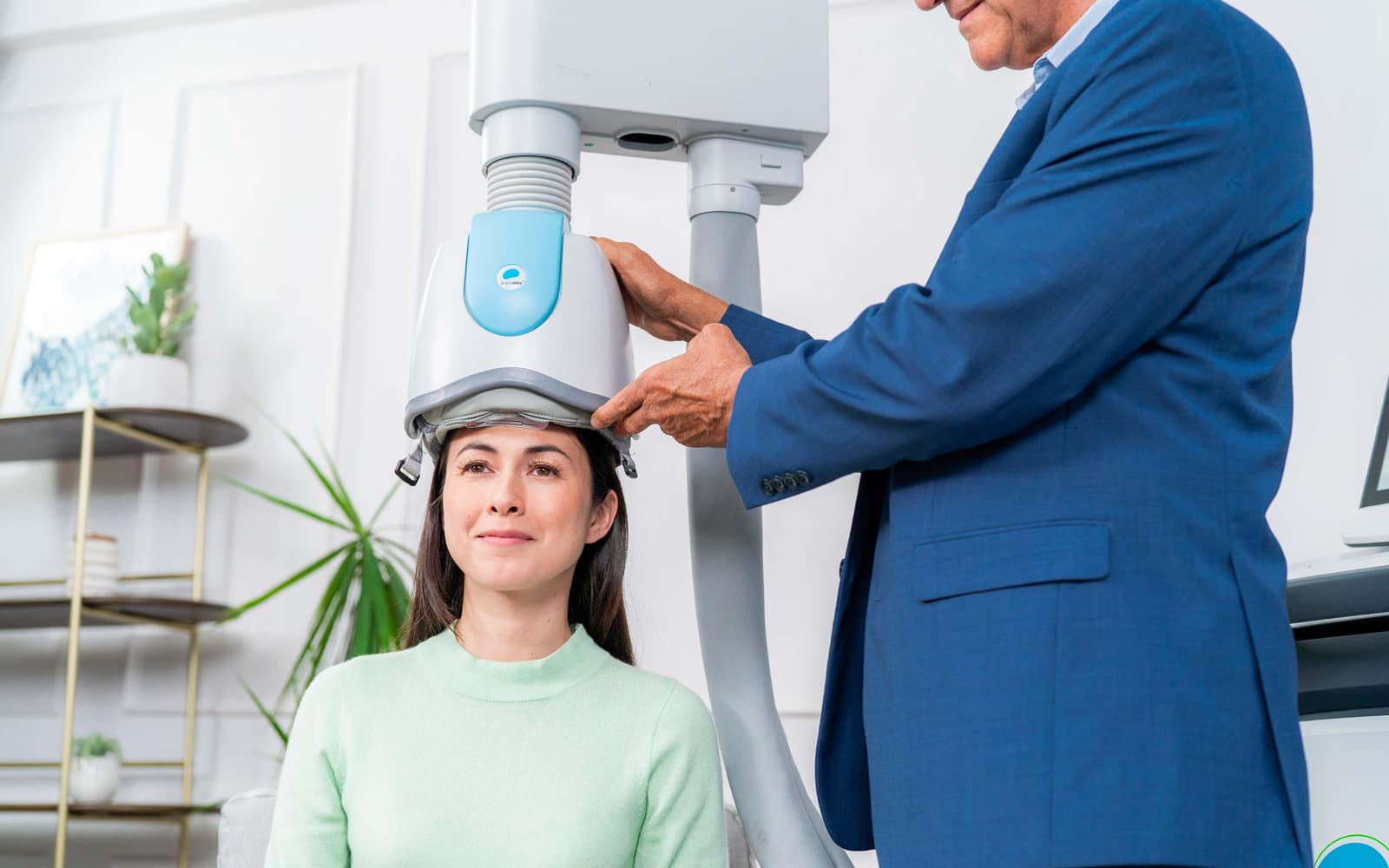
The BrainsWay H7 coil is a helmet-shaped design that produces a broader, deeper field capable of reaching those structures. It received FDA clearance for OCD in 2018 — a clearance separate from the H1 coil used for depression. Treating OCD with it is an on-label use of a device cleared for exactly this condition.
What the evidence shows
Honest about the numbers
Clearance rested on a multicenter randomized trial in patients whose OCD had not responded adequately to standard treatment. At the six-week endpoint, roughly one in three patients receiving active treatment met the trial's response threshold, compared with roughly one in nine receiving sham.
Two things about that are worth saying plainly. It is a meaningful result in a population that had already failed other treatments — and it also means most participants did not reach the response threshold in six weeks. Deep TMS is a real option for treatment-resistant OCD. It is not a guarantee, and anyone who presents it as one is overselling it.
Response is also not binary. Dr. Beasley tracks your symptoms with standardized measures through the course, so the question of whether it is working is answered with data rather than impressions.
The part that surprises people
An OCD session does not begin with the coil. It begins with a brief, individualized symptom provocation — you and Dr. Beasley work out what actually sets off your obsessions, and that is used to activate the relevant circuits immediately before stimulation.
It is deliberate, it is part of the cleared protocol, and it is brief. It is also the reason this treatment benefits from a physician who knows your case — the provocation is specific to you, and getting it right is clinical work rather than a setting on a machine.
What a course involves
Treatment is a course of short daily weekday sessions over several weeks, not a single appointment. You are awake throughout, and you can drive yourself home and go straight back to your day — there is no sedation and no recovery period.
Most people notice change gradually across the course rather than suddenly. Dr. Beasley will tell you what to expect for your situation at the evaluation, including how long before it is reasonable to judge whether it is working.
Candidacy
Who this is for
- OCD that hasn't responded adequately to medication and therapy — typically an SSRI trial at an adequate dose and duration, and exposure and response prevention (ERP) if it has been available to you
- You want a treatment that works through a different mechanism than another medication
- You have OCD and depression together, and would rather have both assessed by one physician
There are also reasons Dr. Beasley will say no. Metal implanted in or near the head, certain implanted devices, and a seizure history all require careful review and may rule treatment out. And if you have not yet had a proper trial of ERP — the psychotherapy with the strongest evidence base in OCD — that conversation comes first. Skipping straight to a device because it is the newer option is not better care.
More about Deep TMS at this practice If depression, rather than OCD, is the main problem
Common questions
Straight answers about TMS for OCD
Is TMS FDA-cleared for OCD, or is this off-label?
How is TMS for OCD different from TMS for depression?
Do I have to stop my medication?
Does it hurt?
Is TMS for OCD covered by insurance?
What if I have both OCD and depression?
Now accepting new patients
Find out whether Deep TMS fits your OCD.
Request an evaluation and Dr. Beasley will review what you have already tried, screen for safety, and tell you honestly whether the H7 coil is the right next step — including if he thinks something else should come first. New patients are typically seen within days.